Jared R. Auclair and Rominder Singh
The Biopharmaceutical Analysis Training Laboratory (BATL) at Northeastern University's Burlington Innovation Campus stands as a testament to the power of collaboration between academia, drug regulators, and industry in advancing biopharmaceutical harmonization and regulatory guidelines. Established in 2014, BATL has rapidly emerged as a pivotal institution in the global biopharmaceutical landscape, offering cutting-edge training, fostering groundbreaking research, and promoting international regulatory harmonization. As we celebrate a decade of BATL’s contributions, it is crucial to reflect on its journey, achievements, and the profound impact it has had on the biopharmaceutical industry, regulatory authorities, and the core mission of student education. This publication aims to provide a comprehensive overview of BATL’s mission, its significant accomplishments, and its vision for the future, highlighting how this unique facility has become an indispensable resource for professionals, students, and regulators alike. From its state-of-the-art laboratories to its globally recognized training programs, BATL exemplifies the innovative spirit of Northeastern University and its commitment to addressing real-world challenges in the ever-evolving field of biopharmaceuticals.
Visit the BATL website
BATL’s Mission
BATL’s mission is to advance biopharmaceutical education by teaching science- and risk-based approaches, fostering global regulatory convergence, strengthening industry partnerships, and driving use-inspired research to enhance innovation and impact in the field.
Key Accomplishments
Over the past ten years, BATL’s key accomplishments have spanned training, research, and significant contributions to global public health, establishing it as a recognized leader in the biopharmaceutical landscape.
Training Programs
BATL’s training programs are foundational to its mission, serving a diverse audience from students to seasoned industry professionals. A key initiative is BATL’s collaboration with MassBioEd, where it serves as a related technical instruction (RTI) partner. This partnership provides comprehensive registered apprenticeship programs for biomanufacturing assistants and life science support specialists, offering hands-on experience with state-of-the-art equipment and techniques.
Beyond apprenticeships, BATL offers skill-based professional development, including specialized hands-on training in flow cytometry for cell characterization, protein analysis, and quality control. These offerings are continually expanding to include in-demand techniques such as Raman Spectroscopy, Mass Spectrometry, liquid chromatography, and research in other cutting-edge bioanalytical fields. The laboratory has also developed flexible learning modules, such as its Parasitology Online Training. To date, these professional programs have trained over 500 industry professionals.
This commitment to education is also deeply integrated into Northeastern’s curriculum, with BATL faculty offering graduate-level courses within the College of Science’s Masters of Biotechnology program, including “Advanced Bioapplication Laboratory Skills” and “Mass Spectrometry.”
Research Contributions
BATL’s research contributions are directly inspired by the most pressing challenges in biopharmaceutical development. The laboratory has made significant contributions to COVID-19 research, developing novel analytical methods and participating in critical diagnostic testing efforts. Further research has focused on advancing characterization techniques. This includes Multi-Attribute Method (MAM) research, which has enhanced quality control and regulatory compliance, and dedicated research on Adeno-Associated Virus serotype 8 (AAV8) to improve the characterization of gene therapy products.
This body of work is documented in an impressive portfolio of over 57 technical writing posts and numerous peer-reviewed papers in prestigious journals. Key publications demonstrate BATL’s wide-ranging expertise, covering topics such as: LC-MS-based proteomics for protein biomarker quantification; implementation of intact protein MS on commercial SLIM instrumentation; analytical characterization of VLPs through HPLC-based methods; advanced biosensing technologies; site-specific conjugation of native antibodies; biosurveillance methods for tracking SARS-CoV-2 variants; comprehensive characterization of AAV gene therapy products; lipid nanoparticle (LNP) analysis; and the continued development of intact mass analysis and MAMs for biopharmaceutical characterization.
COVID Analytical Lab
A significant spin-off of BATL was the Life Science Testing Center (LSTC), which tested 2 million COVID-19 samples during the global pandemic. The lab served not only Northeastern University’s faculty, staff, and students but also local Boston businesses, Chicago Public Schools, and managed airport-based testing samples from San Francisco, New York, New Jersey, Atlanta, and Washington, DC.
Global Recognition
BATL’s sustained efforts have earned significant global recognition. It has been designated as an APEC Life Science Information Forum Center of Excellence, is an active participant in the International Council for Harmonisation (ICH), and serves as a training partner for the World Health Organization (WHO).
BATL’s Capabilities
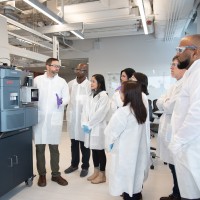
BATL’s impact is enabled by its state-of-the-art facilities, which are housed in a multi-use 6,500 square foot laboratory space designed for workforce development, industrial partnerships, and regulatory program development.
The facility includes lab spaces with comprehensive upstream and downstream biomanufacturing capabilities. This features cell culture rooms with biological safety cabinets and incubators, alongside two biomanufacturing spaces equipped with single-use reactors capable of growing 250mL to 50L batches. Each biomanufacturing lab includes protein purification capabilities. Dedicated space is also allocated for cell and gene therapy manufacturing equipment, including for lipid nanoparticle (LNP) and Chimeric Antigen Receptor (CAR) T-Cell production.
The analytical wing is exceptionally well-equipped, housing five LC-MS systems from Thermo Fisher, Agilent, and Waters for comprehensive small- and large-molecule analysis. It also features next-generation sequencing (NGS) units from Illumina, Thermo Fisher Scientific, Oxford Nanopore Technologies, and Nabsys, a a life sciences company that specializes in electronic genome mapping (EGM) to analyze DNA, particularly structural variations. Additional key resources include RT-PCR, flow cytometry, a Bruker MALDI (Matrix-assisted Laser Desorption/Ionization) unit, and a BrightSpec Molecular Rotational Resonance (MRR) instrument.
A key component of BATL’s training infrastructure is its mock cGMP facility. This environment is used for hands-on training and specialized programs in quality control, GMP, and regulatory science, allowing trainees to experience realistic pharmaceutical manufacturing conditions while adhering to regulatory standards.
Impact on Global Regulators
A core pillar of BATL’s identity is its direct impact on global regulators. BATL has been designated by the International Council for Harmonisation (ICH) to train global regulators on quality guidelines and other ICH standards. As a Center of Excellence (CoE) for ICH Quality guidelines and Coordinator of the Regulatory Harmonization Steering Committee (RHSC) CoEs, BATL has trained numerous regulators from the Asia Pacific region, enhancing regulatory capabilities and promoting consistent regulatory standards.
This reach has extended to Latin America, with specialized programs for participants from Mexico, Brazil, Argentina, Colombia, Chile, and other nations. BATL has also trained regulators from diverse organizations, including the Egyptian Drug Authority (EDA) and Nigerian regulatory agencies, thereby contributing significantly to capacity building. This training, focusing on ICH Quality and Efficacy guidelines, is delivered through in-person sessions and on-site programs at BATL. These efforts are strengthened by partnerships, such as collaborations with internationally renowned experts in regulatory sciences and bioanalytics.
Contributions to the Commonwealth of Massachusetts
BATL makes substantial contributions to the Commonwealth of Massachusetts’s biotechnology ecosystem. By providing specialized training, BATL enhances the local workforce’s capabilities and supports the growth of the state’s biopharmaceutical sector. Its research, innovation, and collaborations with regional companies address pressing industry challenges, attracting international attention to Massachusetts as a hub for biopharmaceutical excellence and contributing to economic development through job creation and industry advancement.
Benefits to the Biopharmaceutical Industry
The biopharma industry derives direct benefits from BATL’s collaborative model. The laboratory has established valuable partnerships with leading companies, including Amgen and Biogen, facilitating knowledge exchange and joint research. A prime example of this synergy is the Regulatory Fellowship Program, developed with Vertex Pharmaceuticals, which provides industry-focused regulatory training that bridges academic learning with practical applications. Ultimately, BATL plays a crucial role in creating a highly trained workforce, addressing the talent gap in specialized analysis and manufacturing, while simultaneously contributing to the advancement of analytical techniques for human biotherapeutics.
Value to Northeastern University
BATL provides immense value to its home institution. It enhances Northeastern University’s research capabilities by providing advanced instrumentation and expertise that support faculty and student investigations. The laboratory offers unique, hands-on learning opportunities for students, strengthening Northeastern’s reputation as a leader in practice-oriented education. The success of BATL has attracted grants and funding that support broader university initiatives, creating employment opportunities for graduates and fostering a dynamic ecosystem of innovation that benefits faculty, students, and industry partners alike.
Vision for the Next 10 Years
As BATL embarks on its next decade, its vision is to adapt to and shape the future of biopharmaceuticals. A primary goal is to adapt to emerging industry trends by incorporating artificial intelligence and machine learning into regulatory sciences, particularly to address the needs of personalized medicine and advanced therapeutics. This includes a focus on advanced technology integration, such as developing and testing next-generation analytical tools and leveraging bioinformatics and data science for regulatory approaches in the Internet of Things (IoT) era. This technological push will be paired with an expansion of BATL’s global reach through new international partnerships and virtual training programs. Future initiatives will also emphasize interdisciplinary collaboration, integrating with fields like nanotechnology and bioengineering to explore AI-driven manufacturing, discovery, and development.
Conclusion
After a decade of significant impact, the Biopharmaceutical Analysis Training Laboratory (BATL) reflects on its achievements in advancing biopharmaceutical analysis and regulatory convergence. BATL has substantially contributed to global regulators, the biopharmaceutical industry, the Commonwealth of Massachusetts, and Northeastern University by enhancing standards, fostering innovation, and developing a skilled workforce. Looking forward, BATL remains committed to addressing emerging industry needs, investing in innovative technologies, and expanding its role as a global leader in biopharmaceutical analysis and regulatory training, ensuring continued excellence in the evolving landscape of global biopharmaceutical industry.